
Cast iron:why does it remain a core choice in industrial manufacturing?
In modern manufacturing,the choice of materials often determines a product’s performance and stability.Among the many metal material available,cast iron still holds irreplaceable position.
So,what exactly are the advantage of cast iron?why does it outperform steel in critical structural components?This article will break it down for you in detail.
What’s iron?
Cast iron is an iron-carbon alloy with a relatively high carbon content,typically between 2% and 4%.Unlike steel,most of the carbon in cast iron exits in the form of graphite,and this unique microstructure gives it a range of excellent properties.
Key advantages of cast iron
excellent castability
Cast iron has excellent fluidity,allowing it to easily fill complex molds,making it highly suitable for manufacturing parts with intricate structures.
Excellent vibration damping capacity
Due to the presence of graphite in its internal structure,cast iron can effectively absorb vibrations.This is why it is widely used for machine tool beds equipment bases.
Good wear resistance
Graphite acts as a natural lubricant within the material,enabling cast iron to exhibit strong wear resistance during long-term use.
Stable machining performance
During CNC Machining ,cast iron is less prone to deformation and offers excellent dimensional stability. Its good machinability also helps improve processing efficiency and accuracy.
Significant cost advantage
Compared to many high-performance alloys,cast iron provides excellent performace at a more cost-effective price,making it an ecomomical choice for industrial production.
Common types of cast iron and their applications
1、Gray cast iron
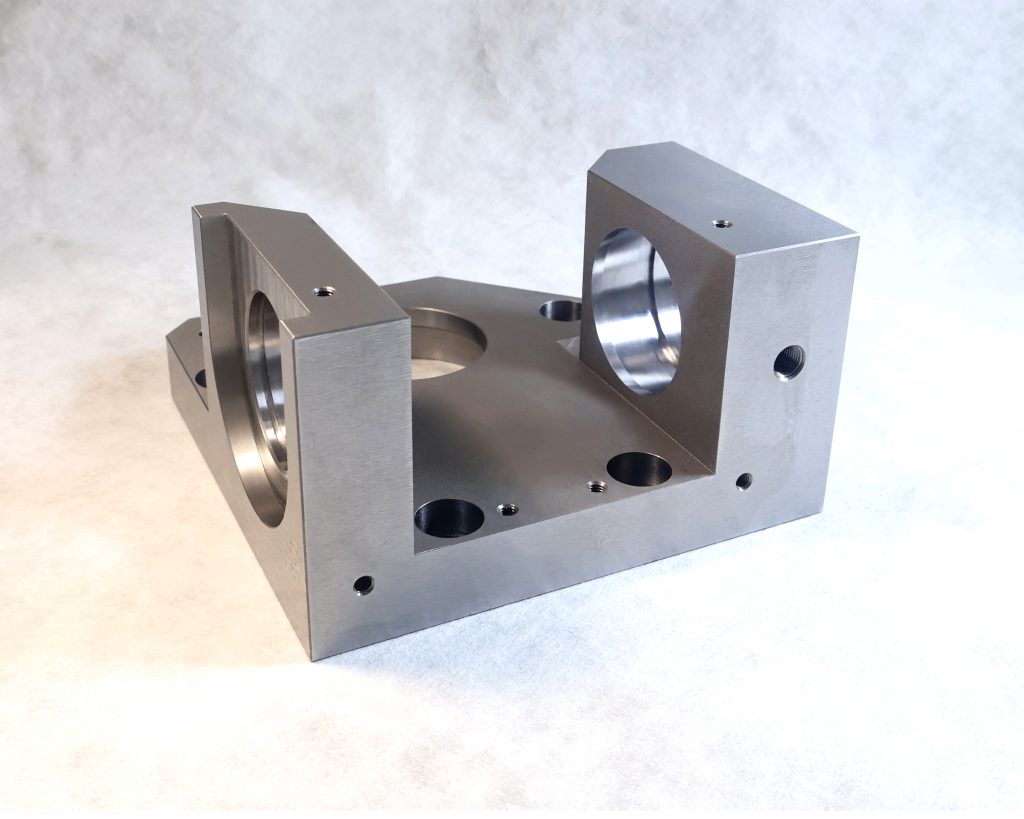
The most common type,known for its excellent vibration damping capacity.
Applications:machine tool beds,pump bodies,and valve bodies.
2. Ductile Cast Iron (Nodular Cast Iron)
Higher strength and toughness, comparable to steel
Application: Automotive components, piping systems
3、White Cast Iron
High hardness and excellent wear resistance,but relatively brittle
Applications:Wear-resistant component
4、Malleable Cast Iron
Gains certain toughness after heat treatment
Application: Small mechanical parts
Why precision machining prefers cast iron?
In the field of precision machining,especially CNC machining,material stability is crucial.
The advantages of cast iron are:
During machining,it is less prone to internal stress deformation,
Making it easier to achieve stable dimensional tolerance and control surface finish quality.This makes it an ideal choice for structural components and high-precision reference parts.